English



首頁 / Procedures / Trademark Infringement Analysis
Trademark Infringement Analysis
Trademark Infringement Analysis Process
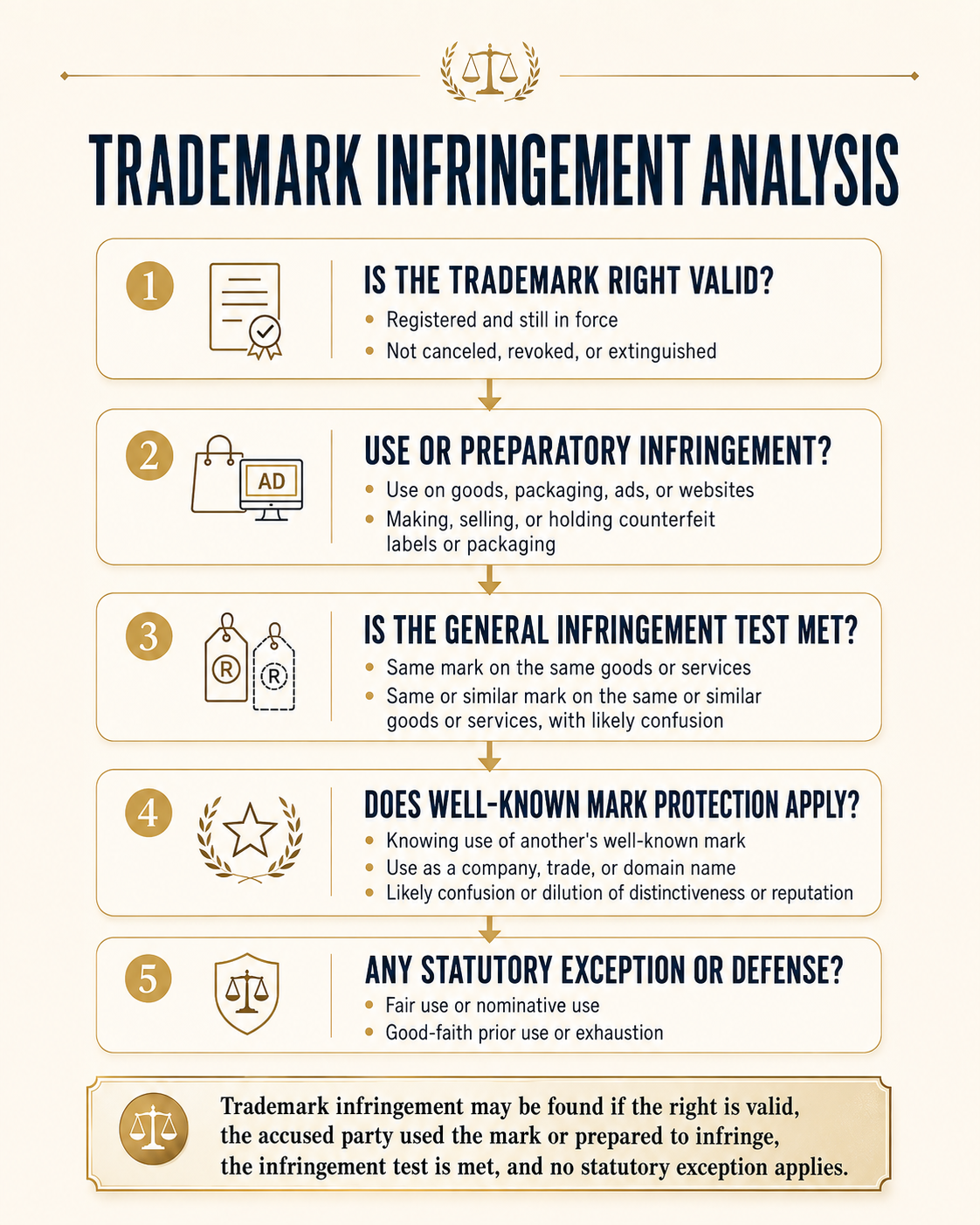
A trademark infringement analysis involves more than comparing whether two signs are similar. It requires an assessment of whether the trademark right is valid, whether the challenged conduct constitutes use of a trademark or conduct covered by Article 68, Paragraph 2, whether the conduct falls within a statutory category of infringement, and whether any lawful limitation or defense applies. Articles 5, 36, 68, 69, and 70 of the Taiwan Trademark Act provide the principal framework for this analysis.
Flowchart | Trademark Infringement Analysis Process
Confirm That the Trademark Right Is Valid and Subsisting
Before asserting trademark infringement, confirm that the trademark right is valid and subsisting. Trademark rights arise upon registration, and the registration must remain within its term without having been cancelled, revoked, extinguished, or invalidated.
If no enforceable trademark right exists, infringement of that right generally cannot be asserted. Depending on the facts, however, the Fair Trade Act, the Civil Code, or other laws may still apply and require separate analysis. Under the Trademark Act, a person seeking trademark rights must apply for registration. Upon publication of registration, the proprietor obtains a ten-year trademark right, renewable for successive ten-year periods.
Determine Whether the Conduct Constitutes Use of a Trademark or Falls Under Article 68, Paragraph 2
Next, determine whether the challenged conduct constitutes use of a trademark or falls within Article 68, Paragraph 2 of the Trademark Act.
Under Article 5, use of a trademark includes applying the mark, in the course of trade, to goods or their packaging or containers; possessing, displaying, selling, exporting, or importing such goods; applying the mark to articles relating to the provision of services; or applying it to commercial documents or advertisements relating to goods or services, where the mark is capable of being recognized by relevant consumers as a trademark. The definition also covers acts performed by digital audiovisual means, through electronic media, on the Internet, or through other media.
Even before goods are sold, Article 68, Paragraph 2 may apply where a person, without the consent of the trademark proprietor and in the course of trade, manufactures, sells, possesses, displays, exports, or imports labels, tags, packaging, containers, or service-related articles bearing a mark identical with or similar to the registered trademark, for use by that person or another in connection with identical or similar goods or services.
If the conduct is neither use of a trademark nor conduct covered by Article 68, Paragraph 2, establishing infringement of the registered trademark right will generally be more difficult.
Assess the General Categories of Infringement Under Article 68
Where the challenged conduct constitutes use of a trademark, the next step is to determine whether it falls within one of the general categories of infringement under Article 68, Paragraph 1. These categories include:
Identical Mark Used for Identical Goods or Services
Use of a mark identical with the registered trademark for goods or services identical with those covered by the registration. This is the most direct category of infringement, and the statutory text does not require a separate showing of likelihood of confusion.
Identical Mark Used for Similar Goods or Services
Use of a mark identical with the registered trademark for similar goods or services, where a likelihood of confusion exists among relevant consumers.
Similar Mark Used for Identical or Similar Goods or Services
Use of a mark similar to the registered trademark for identical or similar goods or services, where a likelihood of confusion exists among relevant consumers.
The principal considerations under Article 68 are whether the marks are identical or similar, whether the goods or services are identical or similar, and, where required, whether there is a likelihood of confusion among relevant consumers.
Separately Assess Protection for Well-Known Registered Trademarks Under Article 70
Even where the conduct does not fall squarely within Article 68, the facts should be reviewed to determine whether a well-known registered trademark is implicated. Article 70 identifies acts deemed to constitute infringement and protects the distinctiveness and reputation of well-known registered trademarks.
Common Categories Include:
Knowing Use of an Identical or Similar Mark to a Well-Known Registered Trademark
Knowingly using a mark identical with or similar to a well-known registered trademark owned by another party may be deemed infringement where there is a likelihood of dilution of the distinctiveness or reputation of that trademark.
Use of Words from a Well-Known Registered Trademark in a Business Identifier
Knowingly using words contained in a well-known registered trademark owned by another party as part of a company, business, group, or domain name, or another name identifying a business entity, may be deemed infringement where there is a likelihood of confusion among relevant consumers or dilution of the distinctiveness or reputation of the trademark.
Determine Whether a Statutory Limitation or Defense Applies
Even if the conduct initially falls within Article 68 or Article 70, determine whether Article 36 limits the effect of the registered trademark right.
Common Limitations and Defenses Include:
- Descriptive Fair Use: Use, in accordance with honest practices in industrial or commercial matters, to indicate a name or the term, shape, quality, nature, characteristic, intended purpose, place of origin, or another description of the relevant goods or services, provided the sign is not used as a trademark.
- Nominative Fair Use: Use of the registered trademark where necessary to indicate the intended purpose of goods or services, in accordance with honest practices in industrial or commercial matters, provided the use does not create a likelihood of confusion among relevant consumers.
- Bona Fide Prior Use: Bona fide use, before the filing date of the registered trademark, of an identical or similar mark for identical or similar goods or services, limited in principle to the original extent of use.
- Exhaustion of Trademark Rights: Once goods bearing the registered trademark have been placed on the domestic or foreign market by the proprietor or with consent, the proprietor generally may not assert the trademark right against those goods. This does not apply where the condition of the goods has been changed, impaired, reprocessed, or reformed, or where other legitimate reasons exist.
Reach an Overall Determination and Assess Available Remedies
Trademark infringement may be established only where the trademark right is valid, the challenged conduct constitutes use of a trademark or conduct covered by Article 68, Paragraph 2, the conduct falls within Article 68 or Article 70, and no applicable limitation or defense under Article 36 applies.
Where infringement is established, Article 69 allows the proprietor to demand that infringement cease and that threatened infringement be prevented. The proprietor may also seek destruction of infringing articles and the materials or implements used in the infringement, subject to proportionality. If the infringer acted knowingly or had reasonable grounds to know of the infringement, the proprietor may also claim damages.
Brief Conclusion
Trademark infringement analysis is not limited to comparing the similarity of two signs. It requires sequential consideration of whether the trademark right is valid, whether the challenged conduct constitutes use of a trademark or conduct covered by Article 68, Paragraph 2, whether Article 68 or Article 70 applies, and whether Article 36 provides a statutory limitation or defense.
Only where an enforceable trademark right exists, the challenged conduct falls within a statutory category of infringement, and no applicable limitation or defense applies may trademark infringement be found.