English



首頁 / Procedures / Patent Infringement Analysis
Patent Infringement Analysis
Patent Infringement Analysis Process
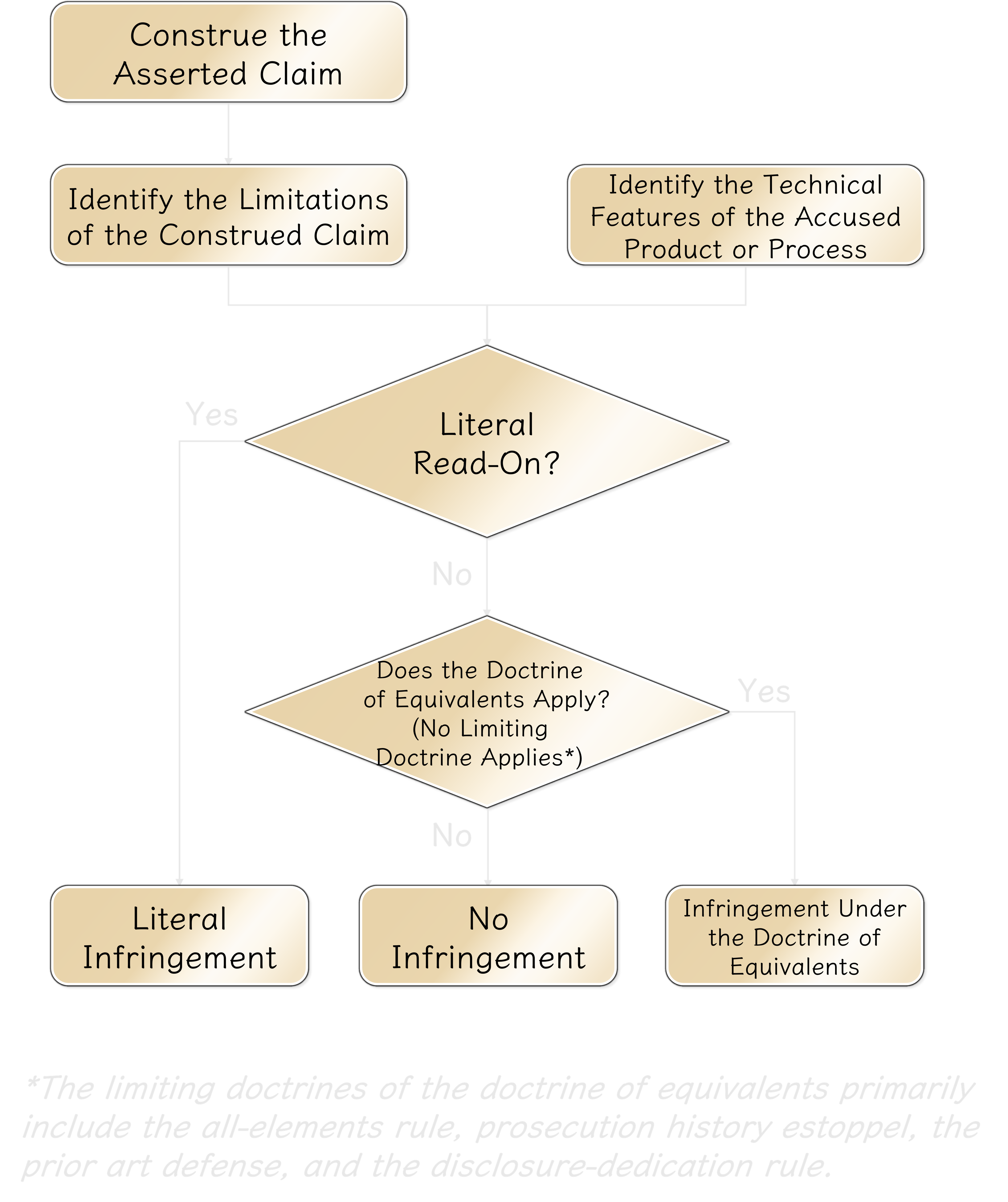
The central question in a patent infringement analysis is whether the accused product or process falls within the scope of the patent at issue. The analysis begins with claim construction to determine the literal scope of the asserted claim, followed by identification of the claim limitations and comparison with the technical features of the accused product or process.
Legal Effect of Patent Rights
Under the Taiwan Patent Act, an invention patentee has the exclusive right, during the patent term, to prevent others from exploiting the patented invention without consent. For a product invention, exploitation includes making, offering for sale, selling, using, or importing the product for those purposes. For a process invention, exploitation includes using the process and using, offering for sale, selling, or importing for those purposes a product obtained directly by that process.
Basis of the Infringement Analysis
Whether patent infringement is established turns on whether the accused product or process falls within the scope of the patent at issue. The Directions for Determining Patent Infringement (2016), issued by the Taiwan Intellectual Property Office, provide that the analysis for invention and utility model patents begins with construction of the asserted claim to determine its literal scope. The limitations of the construed claim are then identified and compared with the technical features of the accused product or process.
Patent Infringement Analysis Process
Determine Whether the Accused Product or Process Literally Reads on the Claim
If every limitation of the construed claim is present in the accused product or process, the claim literally reads on the accused product or process and literal infringement is established.
If the claim does not literally read on the accused product or process and the patentee invokes the doctrine of equivalents, the analysis proceeds to whether infringement exists under the doctrine of equivalents.
Determine Whether the Doctrine of Equivalents Applies
The doctrine of equivalents prevents an accused infringer from avoiding infringement merely by making an insubstantial change to, or substitution for, a claim limitation.
When determining whether the doctrine applies, the analysis must also consider its limiting doctrines: the all-elements rule, prosecution history estoppel, the prior art defense, and the disclosure-dedication rule.
If any limiting doctrine applies, the doctrine of equivalents does not apply and no infringement under the doctrine of equivalents is found. If none applies and the accused product or process is equivalent to the claimed invention, infringement under the doctrine of equivalents is found; otherwise, it is not.
Source: Taiwan Intellectual Property Office, Directions for Determining Patent Infringement (2016).
A patent infringement analysis begins with claim construction, followed by an assessment of literal infringement, the doctrine of equivalents, and its limiting doctrines to determine whether the accused product or process falls within the scope of the patent.